Lutòpia · 2026

MIRADEMON

AKA Sympathy for the Devil Installation.

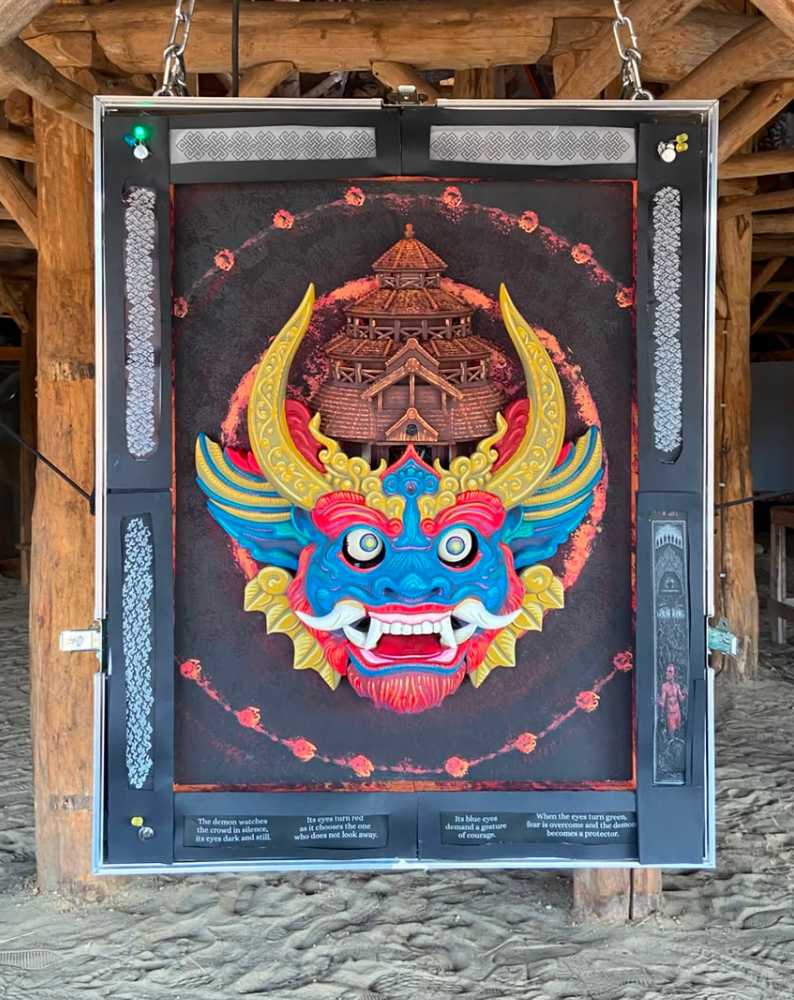
Mirademon is a cinematic installation willing to interact and bond in some ways with the festival attendees.

A living kinetic installation, will try to survive itself within the Ozora week, like all of us. Be kind to the demon and it will treat you back :).

Answering some question to Sara Fehrer from Ozora Team for the Ozorian Prophet

How did you come up with the Sympathy for the Devil interactive exhibition?

I read that Ozora was looking for totems to decorate certain places.

I thought about creating one — or even more than one — to leave around.

The initial idea was for them to be battery-powered, but with a few small electronic components that would allow them to interact with passersby: an eye that follows you, an exchange of some kind—first fear/awe, then discovery and recognition.

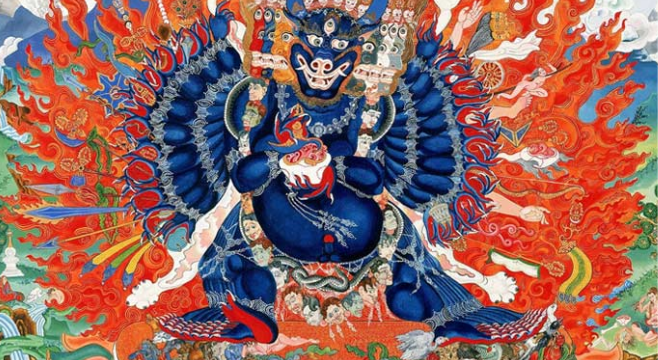
This brought to mind the concept of the demon from Asian tradition, which actually represents a part of ourselves that, once confronted, protects us.

It’s all very Jungian in its own way, and there’s a lot of psychedelia in this catharsis.

I made a few sketches on paper (strictly without using AI!) and submitted this one within the call’s guidelines.

Tibetan iconic demon Māra / bdud is the demon of obstruction: the force that attacks the mind at the threshold of awakening. It appears as fear, desire, anger, doubt, and illusion. It is not simply an external monster, but a projection of inner resistance. Māra is “defeated” not by violence, but by recognition, stillness, and awareness. By facing these figures, individuals are reminded to acknowledge and master their own destructive impulses. In this way, demons become protectors and teachers rather than purely malevolent entities.
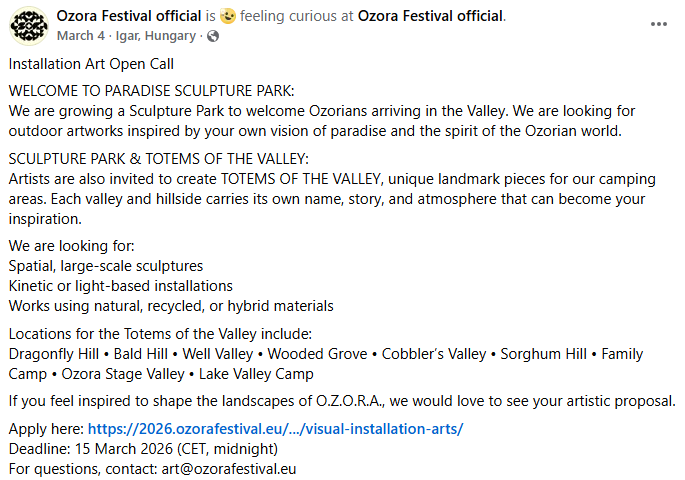
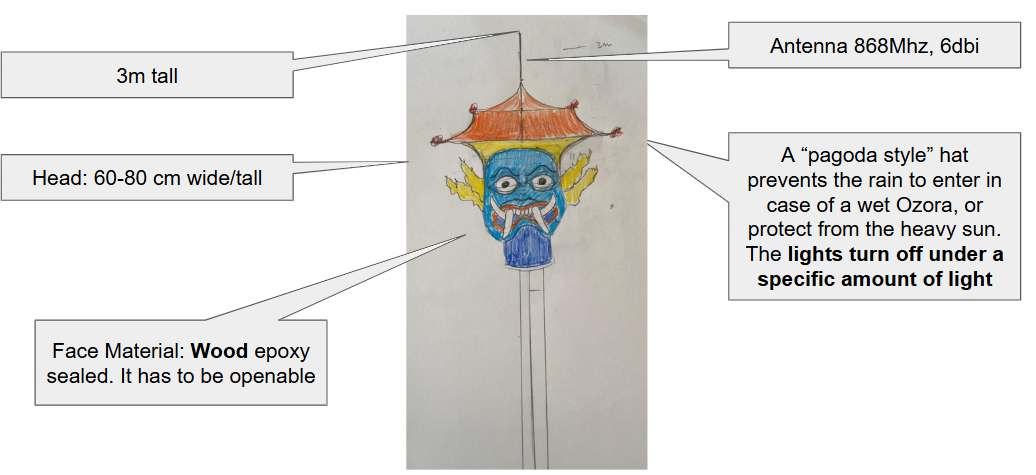
Ozora call sketch — Sympathy for the Devil
Early Mirademon sketch

What does the title/concept express for you?

The idea behind the concept of “Sympathy for the Devil” is to confront one’s destructive impulses—the experiences we may not be too proud of—and to accept them in order to become a better person.

I think this is one of the defining moments in human history and one of the great questions lying dormant behind the attempt to temporarily suppress our ego in search of a catharsis that allows us to live with our suffering.

I apologize if I sound too gloomy or even too deep—and perhaps a bit rhetorical!

The fact that the installation uses a local artificial intelligence model is in itself a very powerful symbol, both of how this technology is used in relation to us humans and on a purely visual level.

What can guests expect?

Viewers will see a kinetic statue, a sort of puppet (my father calls it “babachu (baˈbatʃu)” which in Piedmontese means “little toy,” or perhaps even “marionette”) made “in the style of” or inspired by Hindu and Buddhist traditions, with interactive elements that seek to create some kind of interaction with the audience.

At worst, it will be just eye contact.

A gesture (or a series of gestures) from the viewer can calm or soothe the demon, which will then return to rest and leave you alone.

There’s a lot to unpack here as well. There’s an issue of cultural appropriation. I want to make it clear that my team and I were motivated by a deep respect for the various cultures we drew upon, so I’ve emphasized three times that our intention was not to offend anyone! I remember a wonderful book by Eric Hobsbawm — The Invention of Tradition — in which he discussed how countless traditions and customs were created from scratch.

In this installation, this shrine or tabernacle dedicated to a completely nonexistent entity represents precisely that (as do its decorations — as we’ll see shortly). On the sides, there are decorations running along the frame. The surface is made of wood, but I’ve embedded magnets inside that allow the images on the sides of the installation to be changed from year to year—or even from day to day. For now, I’ve created some standard geometric patterns, but I thought that

Early Mirademon sketch

How is it part of your ongoing project experiments at Ozora and your work outside it?

This project—Sympathy for the Devil, or as I now more often call it: the Mirademone—is a convergence of my work as an instructor in digital arts, automation, remote monitoring, and programming, and the world of festivals and TAZs.

In recent years, I’ve collaborated with various organizations, such as the Istituto Marangoni in Milan and MOME in Budapest, which operate in the field of “immersive digital experiences.”

I’ve also done a lot of work integrating small, local AI models into microcontrollers or small computers. Although the topic of AI is highly controversial, these models are (often, and in this installation absolutely) open-source, and they don’t consume much power because they’re embedded within the system.

Using some tools from Seeedstudio, I led a workshop on Italian gestures in Budapest this spring, and it was wonderful to show the students from MOME Robotisc how AI is something malleable—not just the control tool it’s becoming.

In conclusion, this project is certainly a very interesting case study from both an anthropological and a purely architectural perspective. And I’m doing it for my favorite festival!

Mirademon 2026

Mirademon is an interactive kinetic and animatronic sculpture created as part of Ozora's Totem call.

A Seeed Studio reCamera acts as its digital eye, using a standard computer-vision model (YOLO11) to perceive the surrounding environment.

A Seeed Studio reTerminal coordinates the creature's behaviour through Node-RED, Python and Flask, controlling its eyes, jaw, LEDs, sound and servo mechanisms.

It watches. It moves. It reacts. It becomes aware of the presence of the people around it and try to negotiate an interaction with them.

How it works

Human presence
reCamera + Computer Vision
reTerminal
Node-RED + Python + Flask
PCA9685 + hardware control
Eyes · Jaw · LEDs · Sound - Frame

Tools and technologies

Hardware

  • Seeed Studio reCamera
  • Seeed Studio reTerminal
  • Raspberry Pi Compute Module
  • PCA9685 servo control
  • Servomotors
  • Addressable LEDs
  • Sensors
  • Audio hardware

Software

  • Node-RED
  • Python
  • Flask
  • Computer vision / Ultralytics
  • Arduino
  • ChatPT
  • ZBrush
  • Gemini
  • Arduino
  • Tripo AI

Digital fabrication and design

  • inkscape
  • freeCAD
  • TinkerCAD
  • CURA
  • Maya
  • 3D printing
  • CAD and digital fabrication tools

Team

People who shaped this experiment — to be updated.

Thanks to

Mirademon exists thanks to the people, communities and organisations that supported its development.

Ozora

For providing the space, the community and the freedom to experiment.